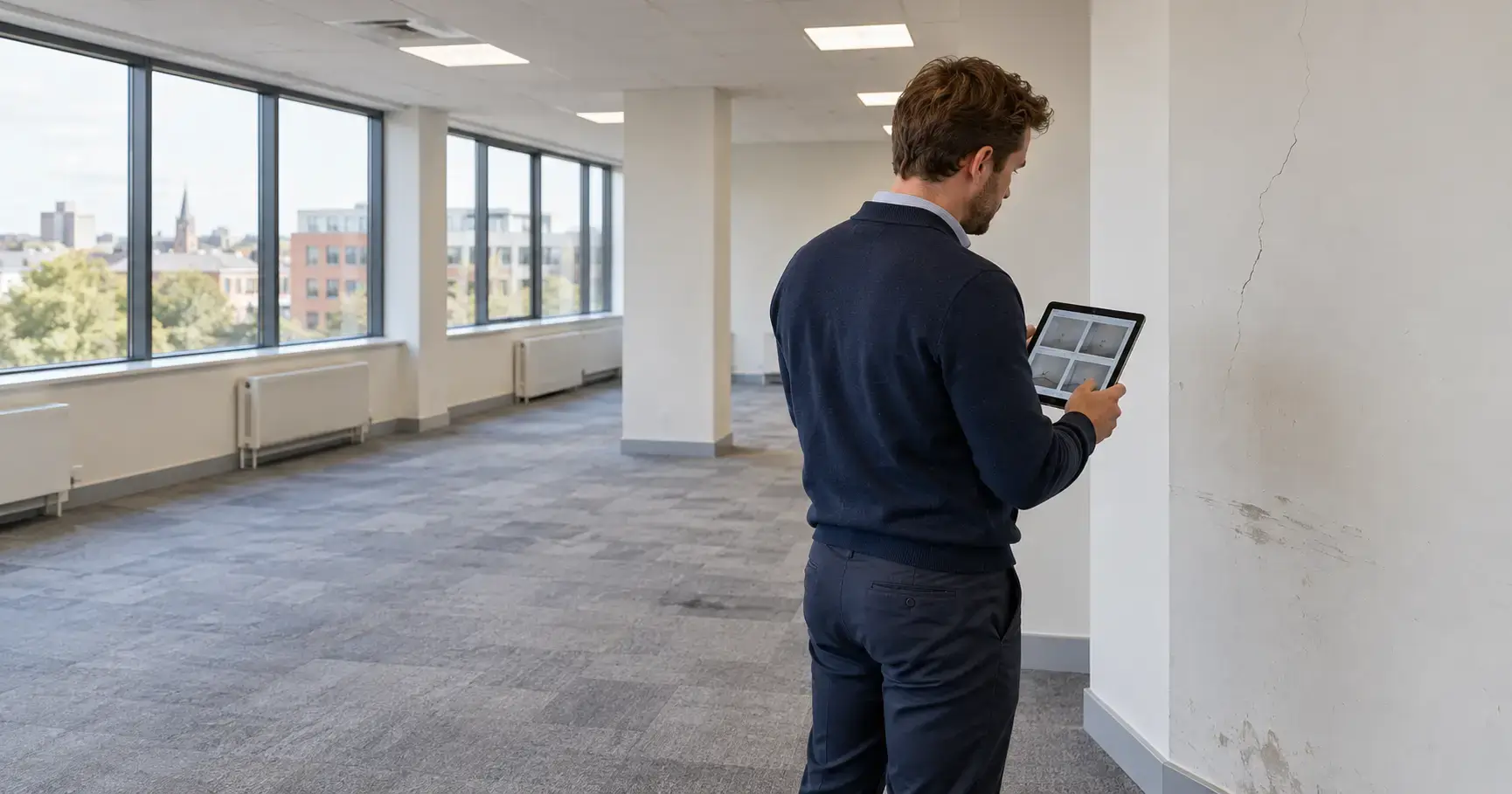
Most tenants don’t think about dilapidations until they’re staring at a claim for thousands of pounds, weeks before they’re due to hand the keys back. By then, there’s very little room left to argue. This is what a dilapidations claim actually involves – and why the moment to protect yourself against one is before you sign the lease, not after.
What “dilapidations” actually means
Dilapidations is the term for a landlord’s claim against a tenant for breaching the repair, decoration, or reinstatement obligations set out in the lease. In practice, it’s usually raised at or near the end of the tenancy, when the landlord’s surveyor inspects the property and compares its condition to what the lease says it should be.
If the surveyor finds the property falls short – damaged flooring, missing fixtures, alterations that were never reinstated, general disrepair – the landlord can issue a Schedule of Dilapidations: a formal list of the works required, or a financial claim in lieu of the tenant carrying them out.
Why these claims are so hard to fight without evidence
Here’s the problem for tenants: most commercial leases put the burden of proof on you. If the landlord’s surveyor says a mark on the floor is damage you caused, and you have no dated record of the property’s condition when you moved in, you’re arguing against a professional opinion with nothing to counter it but your own recollection.
Landlords know this. It’s not that most landlords are acting in bad faith – it’s that the lease structure itself gives them the benefit of the doubt when there’s no independent baseline. A crack that was already there, a stain from a leak that predates your tenancy, wear on a floor finish from the previous occupier – all of it can end up billed to you, simply because nobody can prove otherwise.
What these claims typically cover
Dilapidations claims commonly include:
- Cost of repairs to bring the property up to the required standard
- Reinstatement of alterations (removing partitions, fit-out, cabling, signage)
- Redecoration costs
- Loss of rent while repair works are carried out
- The landlord’s own surveyor’s fees, in some cases
Individually, these might sound manageable. Added together on a property you’ve occupied for several years, they routinely run into five figures – and for larger industrial or warehouse units, considerably more.
Why timing makes it worse
The claim usually lands at the worst possible moment: near the end of the lease, when you’re already managing a move, a new fit-out, or a break clause deadline. Negotiating from that position is harder than negotiating from a position of documented evidence. Landlords also know that tenants under time pressure are more likely to settle than fight.
How a Schedule of Condition changes the outcome
A Schedule of Condition, prepared before you took occupation and annexed to the lease, draws a line. Your repairing obligation becomes “return the property in no worse condition than this document shows” – not “return it in pristine condition regardless of what state it
started in.”
That single distinction is usually what separates a manageable, negotiated dilapidations discussion from an open-ended claim with no natural ceiling. It doesn’t remove your obligations. It just means you’re only ever accountable for what actually happened during your tenancy.
The real cost comparison
A Schedule of Condition is a fixed, modest cost, paid once, before you move in. A dilapidations dispute is an unpredictable cost, often disputed, sometimes involving solicitors on both sides, arriving at a point when you have the least leverage to negotiate. Set side by side, it’s not a close call.
Don’t wait for a dilapidations claim to find out what you should have documented. Get a fixed-fee Schedule of Condition estimate at leasesoc.co.uk/instant-fee-calculator before you sign.